As the tradition tells it
The legend
This is how the tradition tells its own beginning. It is sacred story, not a historical record.
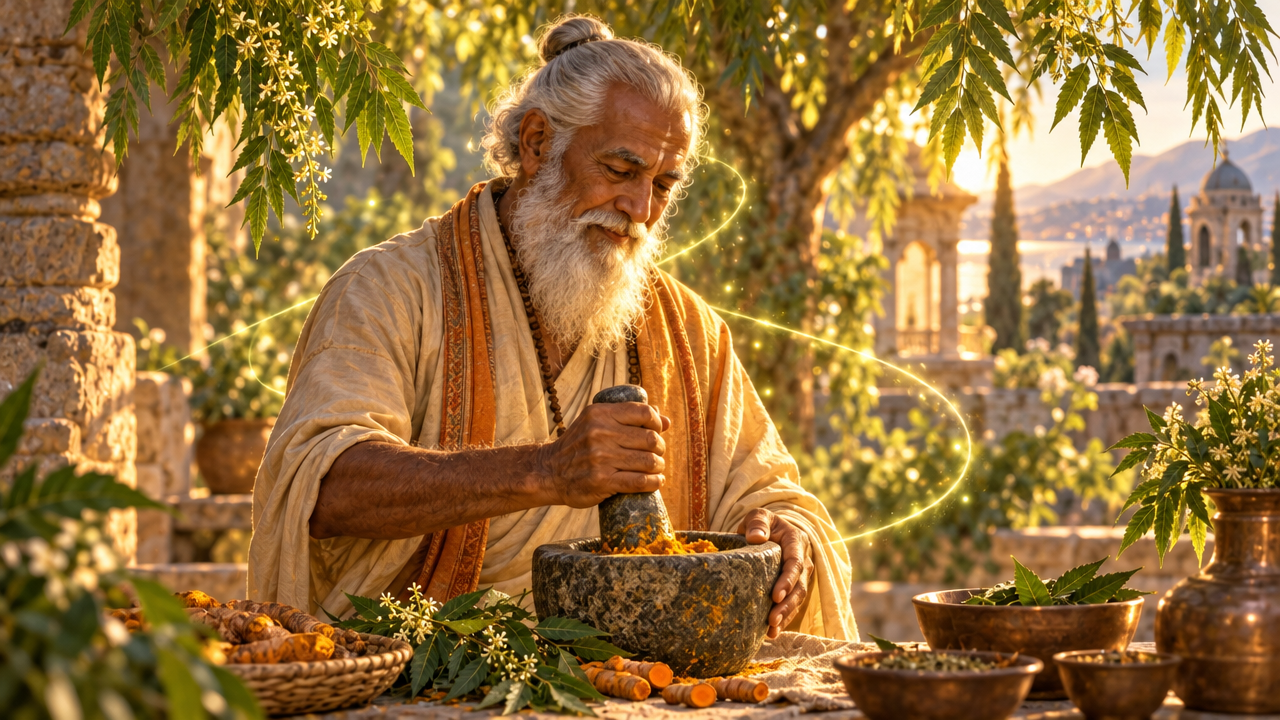
The gods and the demons are churning the cosmic ocean. They are hunting for amrita, the nectar of immortality. Out of the foaming water rises a radiant figure holding a pot of that nectar. His name is Dhanvantari, and the Puranas and epics remember him as the physician of the gods. (He belongs to these later sacred texts, not to the Vedas themselves, where the divine healers are the Ashvin twins.) Tradition says he arranged the healing knowledge into eight divisions and taught it aloud, by word of mouth 619.
A second story, told at the opening of the Charaka Samhita, explains how that knowledge reached people. Ayurveda (from ayus, "life", and veda, "knowledge") was not invented, the tradition says. It was remembered. Brahma, the creator, recalled it and passed it to Daksha Prajapati. Daksha gave it to the Ashvins, the divine twin physicians, and the Ashvins taught Indra, king of the gods 78.
Then the story comes down to earth. Troubled by human illness, the great sages sent one of their own, Bharadvaja, up to Indra to learn the whole science. Bharadvaja brought it back, and it passed to the sage Atreya. Atreya taught six students: Agnivesha, Bhela, Jatukarna, Parashara, Harita and Ksharapani 78.
The surgeons have their own branch of the story, told at the opening of the Sushruta Samhita. Divodasa, king of Kashi (today's Varanasi), was said to be Dhanvantari born again on earth, holding the healing art that had come down from Indra. In the tradition's telling he taught surgery (shalya) to a circle of students, and the most famous of them was Sushruta 78.
The tellings differ, and that is part of their beauty: physicians and surgeons each kept their own family tree back to the gods.
HistoryWhat the written record shows
What the record shows
The oldest layer is the Atharvaveda, one of the four Vedas (India's earliest sacred collections). Britannica places the earliest Ayurvedic ideas there and says, with care, that its verses may possibly reach back to the 2nd millennium BCE 12. No one can give the Vedas an exact date; Britannica notes that most scholars accept about 1500 to 1200 BCE for the earliest Vedic composition, and the Atharvaveda is generally thought to have taken shape somewhat later 20. The cardiac surgeon and historian M. S. Valiathan places the Atharvan period of healing at about 1500 BCE. By his count, in Maurice Bloomfield's collection of its hymns, 65 deal with curing disease and 10 with health and long life 9. In that world, illness was often read as the work of offended gods or harmful spirits. The main remedy was the chanted hymn, with herbs and rites in support 19.
The great change came with two medical encyclopedias, called samhitas ("compilations").
- The Charaka Samhita concentrates on internal medicine. By tradition it is the work of Agnivesha, Atreya's student, which Charaka later edited and expanded 69. Britannica dates its present form to about the 1st century CE and notes that earlier versions existed 1. Valiathan places it in the Kushan period of the same century 9.
- The Sushruta Samhita is the surgeon's book. Britannica says it probably began in the last centuries BCE and reached its present form by about the 7th century CE 1. Valiathan says it was revised from an earlier text in the 4th century 9. The British Library describes it as thought to date to the middle of the first millennium BCE 3.
Why do the dates spread so widely? These books grew in layers over centuries. Each editor added to, revised or rearranged the work of the last, so the "date" of a samhita depends on which layer you mean. The ideas are old; the books as we have them are later.
A third classic followed. Vagbhata is named as the author of the Ashtanga Samgraha and the Ashtanga Hridaya. The closing verses of the Samgraha say its author lived in Sindh and was the pupil of a Buddhist teacher 9. Most estimates place the work around the 6th or early 7th century CE, and scholars still debate whether one Vagbhata wrote both books or two different authors did 921.
The oldest physical pages are the most surprising part. In 1890 a young British officer, Lieutenant Hamilton Bower, bought a bundle of birch-bark leaves from a local treasure-seeker near Kucha, on the Silk Road in what is now western China. It is now called the Bower Manuscript and is kept at the Bodleian Library in Oxford. It contains seven Sanskrit works written in an early Gupta-period script. Among them is the Navanitaka, one of the oldest surviving fragments of Indian medical writing, which draws on formulas found in Charaka. The Bodleian's catalogue places the manuscript between the 4th and 6th centuries CE, and several scholars narrow it to the late 5th or early 6th century 1011.
Keepers of the knowledge
Jivaka. Buddhist writings remember him as physician to the Buddha and to King Bimbisara, and say he trained at Takshashila, the ancient center of learning 9. He comes to us from Buddhist tradition rather than from the samhitas, and his story is part history, part beloved legend.
Charaka. Tradition places him among the wandering vaidyas (healers) who went from village to village 9. His great work is a book of reasoning. It asks how a physician should examine, question and judge, and it treats health as balance. He did not write it from nothing. He edited a teacher's text and made it last 9.
Sushruta. He is often called the father of surgery. His samhita is traditionally said to describe about 300 procedures 6. Valiathan lists removing foreign objects, difficult childbirths, cautery (sealing with heat) and setting broken bones among the surgical work 9. The most famous passage tells how to rebuild a nose that had been cut off, using a flap of living skin taken from the cheek 615. In ancient India, cutting off the nose was a punishment 3. (The forehead flap that later became famous as the "Indian method" is a descendant of this idea, recorded many centuries later; see below.)
Vagbhata. He was the great summarizer. His Ashtanga Hridaya ("Heart of the Eight Branches") gathered the older teaching into a single work in verse, and that work later crossed the Himalayas 921.
How it was passed down
For many centuries Ayurveda was something people heard, not something they read. The Vedas were memorized and chanted with careful accuracy, and the medical teaching grew up inside that culture of remembered verse. That is why the samhitas are written largely in verse. Meter is easier to memorize, and a missing syllable breaks the rhythm, so a mistake is easier to hear.
Students learned in a gurukula, the teacher's household, or at great centers such as Takshashila and, later, Nalanda. Valiathan describes the training. Theory was learned by heart and then argued through with the teacher. Practice meant going with him on house calls, gathering herbs and preparing medicines. At the start, the student made a solemn pledge before an assembly of learned people, with a fire as witness 9.
The knowledge also traveled in a quieter way. As centuries passed, surgery moved out of the schools and was handed down within families of practitioners who had no formal schooling. Procedures descended from Sushruta's tradition, nose repair among them, survived in these families. British observers found them still in use in the late 1700s and 1800s 915.
Writing came last. Some of the earliest surviving pages are birch bark, like the Bower Manuscript. Each new copy was another link in the chain: from the Vedic hymns, to the chanted verses of the samhitas, to manuscripts, to printed books.
How it traveled
Alexander's soldiers, around 326 BCE. When Alexander the Great's army pushed into the Indus region, the Greeks met snakes they did not know how to deal with. The Roman-era historian Arrian, who worked from the now-lost account of Alexander's admiral Nearchus, reports Nearchus saying that the Greek physicians had found no remedy for the bite of the Indian snakes, but that Indian healers treated those who were bitten. Nearchus adds that Alexander kept the most skilled Indian healers around him, and had it announced through the camp that anyone who was bitten should come to the royal tent 4. The geographer Strabo, also citing Nearchus, says help was close at hand in Indian roots and drugs 5. That is what the Greek sources say, and no more. They record admiration and practical reliance. They do not show a wholesale exchange of medical theory.
The Silk Road, about 4th to 6th centuries CE. The Bower Manuscript is the physical evidence. Indian medical writing, including formulas found in Charaka, had reached a Buddhist community in Central Asia, on the caravan routes toward China 1011. Valiathan describes Ayurvedic ideas moving into Tibet, China, Korea and the rest of East Asia through Buddhist channels 9.
Tibet, 11th century. Vagbhata's Ashtanga Hridaya was translated into Tibetan and preserved in the Tibetan Buddhist canon. The translation is usually credited to the great translator Rinchen Zangpo (about 958–1055), working with the Indian scholar Jarandhara, though catalogues do not all agree on the credit 21. Tibetan medicine is the subject of its own chapter. Its debt to Indian learning is written into this translation.
Baghdad, late 700s to 800s CE. Under the Abbasid caliphs, scholars gathered medical books from neighboring civilizations and translated them 12. Indian works usually passed first into Persian and then into Arabic 1314. The 10th-century Baghdad bookseller Ibn al-Nadim records that the vizier Yahya ibn Khalid, of the powerful Barmakid family, commissioned an Indian physician named Manka to translate the Sushruta Samhita 14. Later tradition also says Manka treated Caliph Harun al-Rashid 14. An Arabic version of Charaka circulated too; the physician al-Razi later quoted it 14. The details are debated. Which texts were translated, by whom, and through which intermediate language varies from one medieval account to another, and historians treat parts of the story with caution 1314.
The clearest proof is a book. Around 850 CE the Persian-born physician Ali ibn Sahl Rabban al-Tabari finished Firdaws al-Hikma ("Paradise of Wisdom"), one of the earliest comprehensive medical encyclopedias of the Islamic world. He closed it with a full section on Indian medicine, laid out in 36 short parts by one modern study's count. His named sources include the Sushruta Samhita, Charaka's work and the Nidana (a diagnostic text attributed to Madhava) 12. Through books like this one, later physicians in the Islamic world could read Indian ideas about diet, hygiene, the elements and herbal medicine 12.
Europe, by way of Goa, 1563. The Portuguese physician Garcia de Orta, working in Goa, published his Colloquies on the Simples and Drugs of India (Colóquios dos simples e drogas da Índia), a book of dialogues often described as the first extended European account of the medicinal products of the Indian subcontinent. It drew European attention to Indian herbal knowledge 922.
Europe, by way of a nose, 1794. This is the best-documented crossing of all. A Parsi bullock-cart driver named Cowasjee, working with the British army, was taken prisoner by the forces of Tipu Sultan of Mysore during the Third Anglo-Mysore War, around 1792. As punishment his nose and hands were cut off. He lived without a nose for about a year. Then, near Poona (today's Pune), an Indian practitioner described only as a potter rebuilt the nose with a flap of skin from the forehead. Two British surgeons of the Bombay Presidency, Thomas Cruso and James Findlay, watched the operation 15. The story was reported in the Madras Gazette on 4 August 1794 15. In October 1794 a letter signed only "B. L." described it in London's Gentleman's Magazine, pages 891–2 315.
The surgeon Joseph Constantine Carpue studied these reports. On 22 October 1814 (some accounts say the 23rd) he performed the first nose reconstruction in Britain by the Indian method, on an army officer whose nose had collapsed after long mercury treatment for a liver complaint. It took fifteen minutes and there was no anesthetic. Three days later a friend saw the result and cried out, "My God, there is a nose!" 3. Carpue described this case and a second one in his book of 1816 3. Soon after, the German surgeon Carl Ferdinand von Graefe, who also worked on nose reconstruction, is said to have originated the phrase "plastic surgery" 3.
The record holds a striking imbalance. Cowasjee was painted, engraved and written about, but the Indian practitioner who gave him back his face is never named in it 15.
Signature ideas and plants
This section describes what people believed and used. It is history, not medical advice.
At the heart of Ayurveda is balance. In its teaching, everything in the universe is made of five elements: space, air, fire, water and earth. In the body these combine into three doshas (working forces). Vata is linked to air and movement, pitta to fire and transformation, and kapha to water and structure. Health, in this view, means keeping them in the right proportion. Illness means they have drifted out of balance 12.
Care therefore reached into every part of daily life: food, sleep, season, conduct, and plants. The eight branches (ashtanga, "eight limbs") show how wide the field was 9:
- Kayachikitsa: internal medicine
- Shalya: surgery
- Shalakya: head and neck (eyes, ears, nose, throat)
- Kaumarabhritya: care of children
- Bhuta vidya: illnesses believed to have unseen or spirit causes
- Agada tantra: poisons and their treatment
- Rasayana: rejuvenation
- Vajikarana: fertility and virility
Plants were the medicine chest. Nearchus and Strabo saw Indian "roots and drugs" used for snakebite 45. The Bower Manuscript is full of herbal formulas 10. Al-Tabari set out Indian plant knowledge for Arabic-reading physicians 12. Garcia de Orta carried Indian "simples" (single-plant medicines) to European readers 22. The fact that these plants traveled is history. Whether any of them work is a separate question that tradition alone cannot answer.
Today
Ayurveda did not have an easy second millennium. Valiathan writes that it received little state support for centuries under the later dynasties that ruled north India, that it was dismissed by the British colonial administration, and that it went through a long period of stagnation before Indian independence 9. He also describes a modern resurgence 9. Today India has a national government ministry, the Ministry of Ayush, which promotes and regulates its traditional systems of medicine, Ayurveda among them 16. Ayurvedic colleges, hospitals and clinics operate across India, and the tradition is now practiced in many countries.
Modern scientific study of Ayurvedic preparations is active, and its results are mixed. A long history of use is a record of what people believed and practiced. It is not, by itself, proof that something is safe or that it works.
Is it "the oldest"? It is often called the oldest system of medicine, and the honest answer is: it depends what you count.
- Oldest surviving written medical records: Egypt and Mesopotamia come first. The Edwin Smith Papyrus dates to about 1600 BCE and the Ebers Papyrus to about 1550 BCE, and both are copies of even older texts 17. Mesopotamian medical writing on clay tablets reaches back to the late 3rd millennium BCE 18. No Indian medical manuscript survives from anywhere near that early.
- Oldest roots: Ayurveda's roots in the Atharvaveda may reach the 2nd millennium BCE, though that date is uncertain 120. Those roots were preserved in memory and chant, not on papyrus or clay.
- Oldest living tradition: This is Ayurveda's strongest claim, and it shares it with Chinese medicine. The medicine of Egypt and Babylon faded with those civilizations. Ayurveda's classic texts have been copied, studied, taught and practiced for roughly two thousand years, through good centuries and lean ones, and they are still taught today.
The family line
Threads to other traditions
- To the Greeks (about 326 BCE): Alexander's camp relied on Indian healers for snakebite, as recorded by Nearchus and repeated by Arrian and Strabo 45. This was contact and admiration, not proven transfer of theory.
- To Buddhist Central Asia and the Silk Road (about 4th–6th centuries CE): Indian medical texts, including formulas found in Charaka, reached Kucha (Bower Manuscript) 1011.
- To Tibet (11th century CE): Rinchen Zangpo translated Vagbhata's Ashtanga Hridaya into Tibetan 21. See the Tibetan medicine chapter.
- To China, Korea and East Asia: Ideas moved through Buddhist channels 9. The details belong to those chapters.
- To the Islamic world (late 700s–about 850 CE): Sushruta and Charaka passed through Persian into Arabic under the Abbasids, with the Barmakids as patrons 1314. Al-Tabari's Firdaws al-Hikma (about 850) set out Indian medicine for Arabic-reading physicians 12.
- To Europe (1563): Indian herbal knowledge reached Europe through Garcia de Orta's book, printed in Goa 22.
- To modern surgery (1794–1816): The Indian forehead-flap method of nose reconstruction reached Britain through the 1794 Gentleman's Magazine report. Carpue's 1814 operation and 1816 book followed, helping lay the foundations of modern plastic surgery 315.
- Received from others: Ayurveda's direct borrowings from other traditions are less well documented than its gifts. Some medieval Muslim writers believed Indian medicine had been shaped by Greek medicine, a view modern scholars question 12.
Sources
Every bracketed number in this chapter points to one of these.
- Britannica, "History of medicine: Traditional medicine and surgery in Asia." britannica.com
- Britannica, "Ayurveda" (summary and main entry). britannica.com and britannica.com
- British Library, "Britain's first nose job" (blog, 21 October 2016). bl.uk
- Arrian, Indica ch. 15, in J. W. McCrindle's translation, Indian Antiquary vol. 5 (1876), p. 94. jainqq.org
- Strabo, Geography XV.1.45. textbase.scriptorium.ro
- Pondomatti SC et al., "A Literature Review of the Integration of Ancient Indian Mythology in Clinical Medicine," Cureus 16(7): e63779 (2024). pmc.ncbi.nlm.nih.gov
- History of Indian Medicine (and Ayurveda), Wisdom Library (summarizing the descent narratives of the Charaka Samhita, Sutrasthana ch. 1, and the Sushruta Samhita, Sutrasthana ch. 1). wisdomlib.org
- Medindia, "Descent of Ayurveda" (popular summary of the same narratives). medindia.net
- M. S. Valiathan, "Ayurveda," Sahapedia (Knowledge Traditions). sahapedia.org
- Bodleian Libraries, A Catalogue of South Asian Manuscripts, "Bower Manuscript" (dated 4th–6th century). south-asian.bodleian.ox.ac.uk ; with the summary of Hoernle's and Sander's dating at en.wikipedia.org
- History of Information, "The Bower Manuscript, One of the Earliest Treatises on Indian Medicine." historyofinformation.com
- Abdoli M., Mahlooji K., "Paradise of Wisdom: Indian Medical Concepts in a Persian Islamic Medical Text," Acta Medico-Historica Adriatica 20(2): 251–260 (2022). doi.org
- Muslim Heritage, essay on scientific translation and Arabic pharmacy. muslimheritage.com
- Manfred Ullmann, Islamic Medicine (Edinburgh University Press, 1978; repr. 1997), on Ibn al-Nadim's account of Manka, the Barmakids and the Arabic Charaka; summarized with its limits in "Mankah (Ancient Indian physician)," Wikipedia (sourcing limited). en.wikipedia.org
- Hektoen International, "Of honors lost and honor regained: Indian origin of plastic surgery" (2019). hekint.org
- Ministry of Ayush, Government of India (role confirmed only from a search-result summary; page not fetched). ayush.gov.in
- Egypt Museum, "Edwin Smith Medical Papyrus" and "The Ebers Papyrus." egypt-museum.com and egypt-museum.com
- OpenEdition Books (IRD Éditions), chapter on ancient Near Eastern pharmacology and Mesopotamian medical texts. books.openedition.org
- On Dhanvantari's absence from the Vedas and his place in the Puranas and epics: summary of the Puranic sources (Bhagavata, Vishnu, Agni, Vayu and Brahmanda Puranas; Mahabharata) at en.wikipedia.org
- Britannica, "Veda" (on the uncertain dating of the Vedas, c. 1500–1200 BCE for the earliest layer). britannica.com
- On Vagbhata's dating and authorship debate, and the 11th-century Tibetan translation of the Ashtanga Hridaya credited to Rinchen Zangpo with Jarandhara: "Ashtanga Hrdaya," Wikipedia summary of Meulenbeld, A History of Indian Medical Literature, en.wikipedia.org ; Studia Orientalia Electronica (journal.fi), journal.fi ; CiNii bibliographic record of the Tibetan text, cir.nii.ac.jp ; Encyclopedia of Buddhism, "Sowa Rigpa," encyclopediaofbuddhism.org (all seen via search summaries; not fetched in full).
- Encyclopedia.com (Complete Dictionary of Scientific Biography), "Orta, Garcia d'." encyclopedia.com