As the tradition tells it
The legend
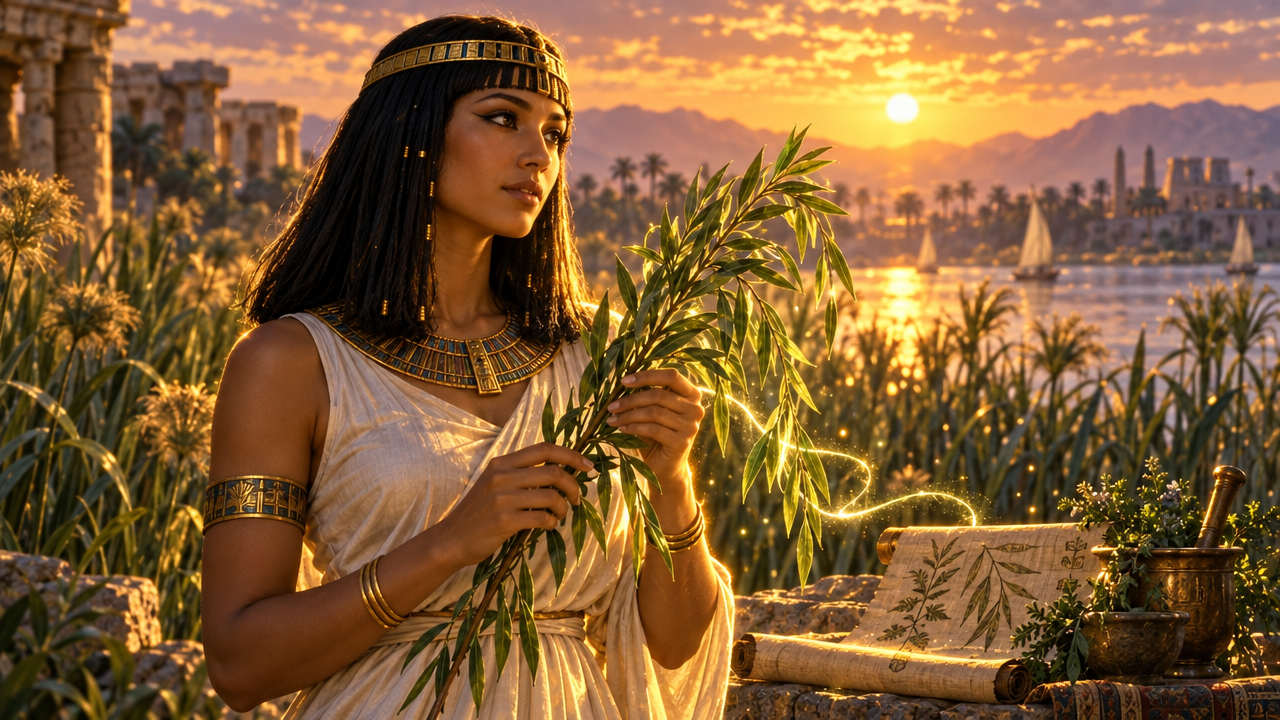
Here is how the tradition tells it.
Long ago, in the white-walled city of Memphis, there lived a wise man named Imhotep. Later tradition made him the son of Ptah, the craftsman god who shaped the world, and also the son of a human architect named Kanofer. That double parentage was a common pattern for Egyptian holy figures 2. Imhotep could raise stone toward the sky. He could read the sacred writings. And, the story goes, he could heal.
When he died, his wisdom did not die with him. Over time people came to his temple at Memphis and lay down to sleep inside its walls. Historians call this "temple sleep," or incubation. Sleepers hoped the god would come to them in a dream and tell them what to do. A Greek papyrus from Oxyrhynchus, written in the second century CE and titled Praise of Imouthes-Asclepius, tells such a story in the first person. The writer's mother had suffered a fever for three years. Mother and son went to the god for help, and the text says she was healed through dreams, and that the son's own fever left him the same night 218.
By then the Greeks living in Egypt had a name for him: Imouthes. They saw in him their own healing god, Asclepius, and they called his temple at Memphis the Asklepieion 12.
That is the legend: a man who became a god of medicine. The record tells a quieter and stranger story, and in some ways a more interesting one.
HistoryWhat the written record shows
What the record shows
Imhotep the man. Imhotep was real. He served King Djoser (also spelled Zoser) of the Third Dynasty, whose reign is usually placed in the twenty-seventh century BCE; exact dates differ from scholar to scholar 12. He was the king's chief minister. He was also the kheri-heb, the chief lector priest who read the sacred texts aloud 2. Tradition credits him with designing the Step Pyramid at Saqqara, the earliest large stone building in Egypt 2.
Here is the surprise. No surviving record from his own lifetime calls Imhotep a physician 1. Britannica thinks he probably did practice medicine, given his rank at court and his later fame as a healer, but that is a reasoned guess, not a proven fact 1. His fame as a healer seems to have grown long after his death 2. In the Late Period, from around the time Persia conquered Egypt in about 525 BCE, he was worshipped as a full god of medicine 2. His cult lasted into Roman times, well over two thousand years after he lived 2. Much later the Canadian physician Sir William Osler called him the first physician to stand out clearly "from the mists of antiquity" 1. Osler's tribute says more about the legend than about the man.
The papyri. The real evidence is a set of scrolls made of papyrus, the paper-like sheets Egyptians made from reeds. Scholars count at least eleven medical papyri. The best known are the Kahun, Ramesseum, Edwin Smith, Ebers, Berlin, Hearst, London, Chester Beatty, Carlsberg, Brooklyn and London-Leiden papyri 8. The Kahun papyrus deals with women's health, including problems conceiving 8. They are written in hieratic, a flowing everyday script, not the picture-signs carved on temple walls 56.
The Ebers Papyrus dates to about 1550 BCE. Britannica calls it one of the oldest known medical works 5. It holds about 700 formulas and remedies 5. Some of them are spells against harmful spirits, and some are practical recipes built from careful observation 5. Its ailments run from crocodile bites to toenail pain, and some recipes are for driving flies, rats and scorpions out of the house 5. The scroll is named for the German Egyptologist Georg Ebers, who acquired it in the 1870s. Britannica gives 1873; other accounts say 1872 5. No one knows exactly where it was found. A story repeated since the 1800s says it was found between the legs of a mummy in the Theban necropolis (a "city of the dead," or burial ground), near what is now Luxor, but that cannot be checked 5. It is now kept at Leipzig University Library 9.
The Edwin Smith Surgical Papyrus is the one that startles modern readers. It was copied in hieratic around 1600 BCE (the U.S. National Library of Medicine says the seventeenth century BCE). It probably draws on material about a thousand years older 34. The American collector Edwin Smith acquired it in Egypt in 1862. At the time it was a single scroll about fifteen feet long 3. After his death his daughter gave it to the New-York Historical Society. It spent ten years at the Brooklyn Museum, and since 1948 it has belonged to the New York Academy of Medicine 4.
Its front side describes 48 cases of injury. Each one follows the same pattern: examination, diagnosis, a verdict on whether to treat, the treatment, and explanatory notes 34. The cases begin at the head and work down the body. The text stops in the middle of a case about the spine, as if the scribe simply put down his pen 4. What strikes historians most is its tone. The National Library of Medicine says the text "is chiefly rational" and contains only one incantation 3. (The back of the scroll is different: it holds several spells and recipes, a reminder that the same owner valued both kinds of help 4.) It is often called the oldest known surgical document 3. It also gives the earliest known written descriptions of the membranes around the brain and the fluid that bathes it 4.
Honest dating. Every date above comes with care attached. The scrolls we hold are copies. Their language suggests older sources, but no one can say exactly how old. When a writer says Egyptian medicine "began" in a certain century, they are guessing past the evidence.
Keepers of the knowledge
Imhotep (Third Dynasty, twenty-seventh century BCE). An architect, priest and royal minister, later turned by devotion into a god of healing. He is a reminder that a tradition's founders are sometimes chosen later, not born at the start.
Hesy-Ra (Third Dynasty). In his tomb at Saqqara, carved wooden panels show an official whose titles are often translated "Chief of Dentists and Physicians" 1019. Many call him the earliest physician known by name. But the key Egyptian words can also be read as "great one of the ivory cutters," which would make him a craftsman, not a dentist. So his title should be read as a translation, not a certainty 19. Another of his titles, "Magician of Mehit," shows how closely healing and religion were tied together 10.
Peseshet (Fourth or Fifth Dynasty, around 2500 BCE). A false door (a carved stone doorway for the spirit of the dead) in a tomb at Giza names her as imy-r swnwt, "Overseer of Female Physicians" 1120. Scholars still debate whether she practiced herself or oversaw the women who did. Either way, her title tells us that women physicians existed in the age of Egypt's great pyramids.
The unnamed scribes. The truest keepers were people whose names we will never know. Someone copied the Edwin Smith cases. Someone else added notes to explain terms that were already old. Their careful handwriting carried the knowledge across a thousand years.
How it was passed down
Egyptian medicine had two kinds of healer, and they worked side by side.
The first was the swnw (said roughly "soo-noo"), the general word for a physician. Above the ordinary swnw stood a ladder of ranks: the wr swnw (chief physician) and the imy-r swnw (overseer of physicians) 10. Medicine was a profession with its own hierarchy.
The second was the priest-healer. Priests of Sekhmet, the fierce lioness goddess believed to send plague and also to take it away, were medically trained. Scholars note that they did not always carry the title swnw 10. The wab priests, whose name means "pure," kept temples ritually clean. Some served Sekhmet and also worked as doctors 10. Egyptians did not see a wall between prayer and practical care. A single treatment might include a spoken charm and a carefully measured ointment.
Knowledge moved in three ways. It was spoken: incantations were recited, and recitation helps memory. It was taught: apprentices learned from masters. And it was written: master texts were copied, re-copied and explained. You can see that chain inside the Edwin Smith papyrus itself, where later notes explain words from an older original 3. Every copy was one link in a chain that stretched back long before the copy itself.
How it traveled
Egypt's healers became famous beyond its borders, and the Greeks did much of the boasting.
Homer, around the eighth century BCE. In the Odyssey, Helen of Troy uses medicines she was given by Polydamna, "an Egyptian." The poet praises Egypt as a land whose soil yields many drugs, some healing and some deadly 1213. The Greek word for those drugs, pharmaka, could mean either medicines or poisons 13.
Herodotus, fifth century BCE. The Greek historian visited Egypt and wrote that medicine there was divided up so that each physician treated a single disease and no more. The whole country, he said, was full of physicians: some for the eyes, some for the head, some for the teeth, some for the belly, some for hidden ailments 67. Historians debate how literally to take this, but it shows how organized Egyptian medicine looked to an outsider.
Herodotus also tells two stories about Egyptian doctors at the Persian court. In the first, King Cyrus of Persia asked the pharaoh Amasis to send him the best eye doctor in Egypt. The physician was taken from his wife and children and sent to Persia. In Herodotus's telling, his resentment later helped push Persia toward invading Egypt 14. In the second, King Darius twisted his foot so badly jumping from his horse while hunting that the ankle was dislocated. He called in the Egyptians he kept close at hand as the best physicians. Their forceful wrenching made the pain worse. A Greek captive, Democedes of Croton, then treated it with gentler Greek methods, and Darius recovered 15. A Greek wrote this story, and it flatters the Greek. Still, it shows that Egyptian physicians served at the Persian court, at least as the Greeks remembered it.
The Hippocratic writings, fifth and fourth centuries BCE. In the Greek medical treatises gathered under the name of Hippocrates, the books on women's health mention a product called "Egyptian oil," used as a soothing ointment 13. Centuries later Galen explained that "Egyptian oil" meant castor oil, and that "Egyptian white oil" was made from lilies 13.
Alexander's conquest, 332 BCE, and after. Once Alexander the Great took Egypt, the Greek and Egyptian worlds became tightly woven together. The flow of Egyptian ingredients into Greek medicine grew 13. Greek physicians used natron (a natural salt), alum and "Egyptian bean" as everyday materials 13. Kuphi, a sacred incense burned daily in Egyptian temples, entered Greek medical writing as an ingredient after Alexander, and appears in Dioscorides and Galen 13. Galen recorded an eye salve called achariston, "the unmerciful," because it was so strong. He wrote that it was the one remedy Egypt's physicians relied on, especially among country people 13. A plaster named after the goddess Isis was said to come from Egypt's temples; some said from the inner rooms of the temple of Ptah at Memphis 13. A later Greek medical text, once credited to Galen, even said Egyptians invented whole branches of medicine, including pharmacology and eye care 13.
There is a twist. Some remedies invented by Greek doctors were also labeled "Egyptian," it seems to make them sound effective, much as a label today might say "imported" 13. Egypt had become a kind of brand.
Signature ideas and plants
The worldview, in plain English. Egyptians saw illness as something with a cause that could be found and dealt with. Sometimes the cause was physical, like a wound or a broken bone. Sometimes it was spiritual, like the anger of a god or a harmful spirit. A good healer did not have to choose between the two. The same scroll could hold a careful bandaging method and a spell 5. The Edwin Smith papyrus shows the practical side at its sharpest. It looks, touches, measures, and then gives an honest verdict, including, in the worst cases, that an injury should not be treated 34.
What the papyri list. The recipes call on a large pharmacy of minerals, animal products and plants. Ochre, a colored clay, appears often 5. Natron, alum, acacia, myrrh and other resins turn up across the Egyptian-Greek record 13.
Honey is everywhere. It turns up again and again in the recipes, often in salves for wounds, and historians who study these texts see it as one of the pharmacy's most common ingredients 16. That is a statement about what Egyptians used, not a promise about what it does.
Willow has a special place in the story of medicine. Writers on Egyptian pharmacy report willow in the Ebers recipes and willow leaves in a wound dressing in the Edwin Smith papyrus 1617. Translating ancient plant names is hard, and some identifications are uncertain 16. Some historians also warn that the popular line from Egyptian willow straight to aspirin is neater than the evidence 21. Thousands of years later, chemists worked out that willow contains salicin, which the body turns into salicylic acid. A chemical relative of salicylic acid became aspirin 17. Egyptians knew nothing of that chemistry. They knew only that willow belonged in the healer's kit. The thread from willow to aspirin is told in this book's final chapter.
Today
Ancient Egyptian medicine is not a living tradition the way some others in this book are. No unbroken line of swnw practices it today. Its life now is in three places.
It lives in the scrolls themselves. The Ebers papyrus is in Leipzig 9. The Edwin Smith papyrus is at the New York Academy of Medicine, and high-resolution scans have been made freely available, with a new translation by James P. Allen 3. Anyone with a screen can now study pages that a scribe inked more than 3,500 years ago.
It lives in scholarship. Egyptologists and historians of medicine keep arguing over dates, word meanings and plant names. Each new translation changes how we read the old texts.
And it lives, quietly, in the Greek and Roman pharmacy it fed. That pharmacy passed through Galen into the medicine of the Islamic world and of Europe. The "Egyptian" remedies in Galen are a faint echo of the House of Ptah, still sounding in later medicine.
The family line
Threads to other traditions
- Gave to Greek medicine (eighth century BCE onward): Egypt's fame as a land of drugs, in Homer's Odyssey (Polydamna) 1213.
- Gave to Greek medicine (fifth and fourth centuries BCE): "Egyptian oil" in the Hippocratic women's treatises 13.
- Gave to Persia (sixth century BCE): Egyptian eye doctors and court physicians serving Cyrus and Darius, according to Herodotus 1415.
- Gave to Hellenistic and Roman pharmacy (after Alexander's conquest of 332 BCE, through Dioscorides in the first century CE and Galen in the second): kuphi, the achariston eye salve, the Isis plaster, natron and alum 13.
- Merged with Greek religion (Greco-Egyptian period): Imhotep identified with Asclepius as "Imouthes," his Memphis temple called the Asklepieion 12.
- Received from Greece (Hellenistic period): a Greek name and a Greek-style healing cult for Imhotep 2. Greek remedies were also relabeled "Egyptian" to borrow Egypt's prestige 13.
- Onward to Islamic and European medicine, indirectly, through Galen's pharmacy (see the Greek and Roman and Islamic Golden Age chapters).
Sources
Every bracketed number in this chapter points to one of these.
- Britannica, "Imhotep": britannica.com
- EBSCO Research Starters, "Imhotep": ebsco.com
- U.S. National Library of Medicine, "An Ancient Medical Treasure at Your Fingertips" (Edwin Smith Papyrus): nlm.nih.gov
- "Edwin Smith Papyrus" (dating, cases, verso contents, custody history): en.wikipedia.org
- Britannica, "Ebers papyrus" (print article), with provenance details from en.wikipedia.org : britannica.com
- World History Encyclopedia, "Herodotus on the Egyptians": worldhistory.org
- Herodotus, Histories 2.84 (Macaulay translation): lexundria.com
- A History of Technology (Rebus Press), "Chapter 3: Ancient Egyptian Medicine" (list of papyri, after J. F. Nunn): press.rebus.community
- New World Encyclopedia, "Edwin Smith Papyrus" and "Ebers papyrus": newworldencyclopedia.org and newworldencyclopedia.org
- Egyptian Journal of Internal Medicine article on ancient Egyptian medicine (swnw ranks, Hesy-Ra, priests of Sekhmet): ejim.springeropen.com
- Current World Archaeology, "Egyptian medicine" (on Peseshet, after Ghalioungui): world-archaeology.com
- Hektoen International, "Helen of Troy: a literary and historical consideration of her role as an ancient Egyptian healer": hekint.org
- Nicola Reggiani (University of Parma), "Egyptian remedies in the Greek medical sources" (conference poster): cre2022.sciencesconf.org
- Herodotus, Histories 3.1 (Godley translation, Perseus/Perseids): fgh.perseids.org
- Herodotus, Histories 3.129–130 (Godley translation, Perseus/Perseids): cts.perseids.org
- "Herbal medicine in ancient Egypt" (review article, PDF copy; seen via search summary only): egittolizzando.altervista.org , and The Past, "Pain relief in ancient Egypt, Part 1: plant-based remedies": the-past.com
- The Past, "Pain relief in ancient Egypt, Part 1: plant-based remedies": the-past.com
- P.Oxy. XI 1381, "Praise of Imouthes-Asclepius" (Grenfell and Hunt, The Oxyrhynchus Papyri vol. XI, 1915), English text as reproduced at: is.muni.cz
- "Hesy-Ra" (title readings "great one of the dentists" / "great one of the ivory cutters"): en.wikipedia.org , and The Past, "Hesyre the dentist": the-past.com
- Harvard Giza Project, "Peseshet (in G 8942)": giza.fas.harvard.edu , and en.wikipedia.org (dating to the Fourth or possibly Fifth Dynasty)
- Asimov Press, "The Uncertain Origins of Aspirin": press.asimov.com